
The relic at the heart of the Order
The Holy Grail
For centuries, the cup preserved in the Cathedral of Valencia has been venerated as the chalice of the Last Supper. This is how it is made, and what each of its parts tells us.
A cup of the first century, crowned by the Middle Ages
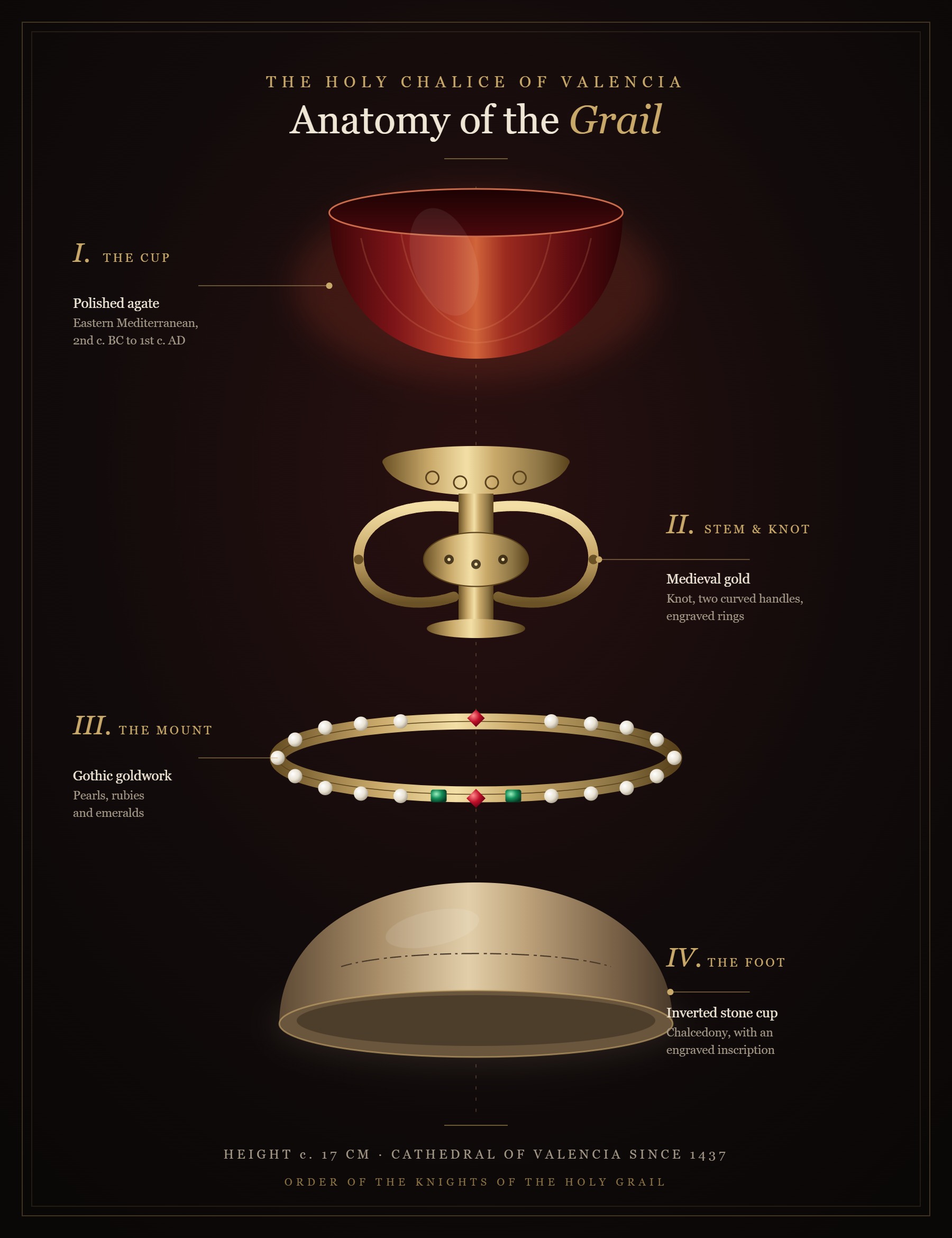
The Holy Chalice of Valencia is not a single object, but three made into one. At its summit is a small cup of polished agate, carved in the eastern Mediterranean between the second century before Christ and the first century after. In the Middle Ages, goldsmiths joined it to a stem with two handles and set it upon a foot of stone, adorned with gold and precious stones. Together they stand about seventeen centimetres high.
I.
The Cup
The only part venerated as the relic itself. A semispherical cup of agate, about nine centimetres across, dark red with vertical bands that glow orange when light passes through it. The archaeologist Antonio Beltrán dated it to a workshop of the eastern Mediterranean at the time of Christ: the kind of precious vessel that could be used at a solemn Paschal meal.
II.
The Stem, the Knot and the Handles
Medieval goldwork binds the cup to the foot. Beneath the cup, a gold collar is engraved with four rings, which some scholars read as the four living creatures of Revelation, symbols of the Evangelists. The stem is decorated with niello rosettes and widened by a knot, where the hand holds the chalice firmly, and two curved handles rise on either side.
III.
The Mount
A Gothic setting in gold frames the foot and carries pearls, rubies and emeralds. A study by the Polytechnic University of Valencia counted twenty-four pearls, one of them now missing, and proposed reading them as the twenty-four elders who worship before the throne of God in the Book of Revelation.
IV.
The Foot
An inverted cup of chalcedony, oval like a small boat, serves as the base. Around it runs an engraved inscription, studied since the 1950s and still debated: some read it in Arabic, others as a Hebrew form of the holy Name.
From the Upper Room to Valencia
- Tradition. Saint Peter brings the cup to Rome. During the persecution of Valerian, in the third century, the deacon Saint Lawrence sends it to safety in his homeland, Huesca.
- 1134. An inventory of the monastery of San Juan de la Peña, in the Pyrenees of Aragon, describes the chalice among its treasures.
- 1399. The monks give the chalice to King Martin I of Aragon.
- 1437. King Alfonso V the Magnanimous entrusts it to the Cathedral of Valencia, where it has been kept ever since.
- 1982 and 2006. Pope John Paul II and Pope Benedict XVI celebrate Mass with the Holy Chalice in Valencia.
Today the road the chalice travelled through Aragon and Valencia is walked again as the Camino del Santo Grial, the pilgrimage at the origin of our Order.
The Grail in our emblem
The emblem of the Order is drawn from this chalice: the knot of its stem, the pearls of its mount, and its handles, rendered as serpents raised up as a figure of Christ, as in the Gospel of John (3:14). Set upon the cross, it reminds every member that the Path begins and ends at the altar. Discover the coat of arms of the Order.

