
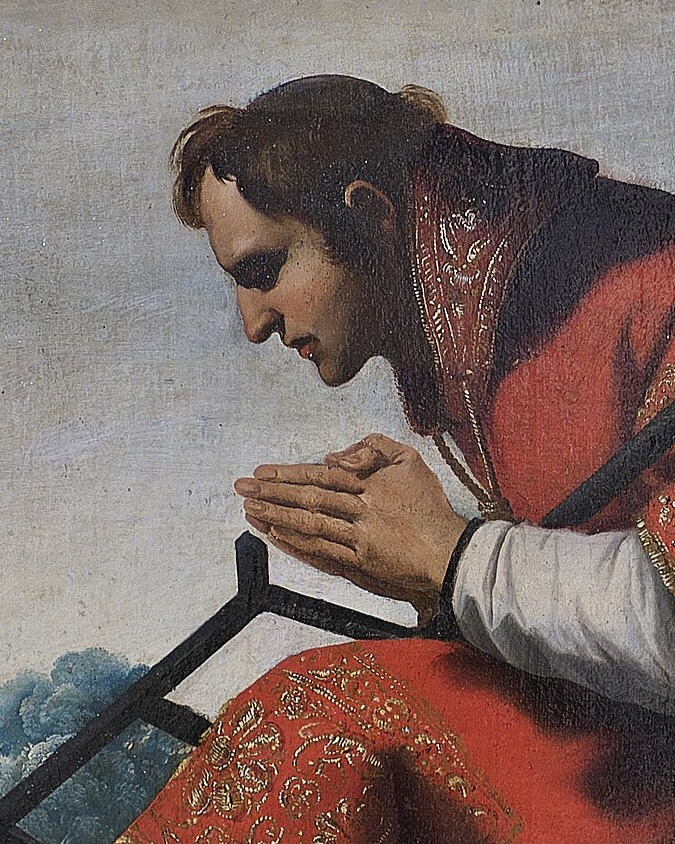
Saint Lawrence is one of the most venerated martyrs of the early Church. Deacon of Rome, keeper of the goods of the Church and, according to tradition, first guardian of the cup of the Last Supper, he is the Patron of the Order of the Knights and Dames of the Holy Grail. Seventeen centuries after his death, his life still speaks with particular force to the young.
A young deacon in Rome
Lawrence served the Church of Rome in the middle of the third century as one of its seven deacons, under Pope Sixtus II. A tradition preserved in Aragon holds that he was born in Huesca, in the north of Spain, and that he had come to Rome as a young man. The deacons of Rome were responsible for the goods of the community and for the care of the poor, the widows and the sick of the city.
The treasures of the Church
In 258 the Emperor Valerian ordered the persecution of the clergy. Pope Sixtus II was arrested and put to death on 6 August with several of his deacons. According to tradition, before his death the Pope entrusted the treasures of the Church to Lawrence, and Lawrence sent the cup of the Last Supper to his family in Huesca, where it would be guarded for centuries before reaching the Cathedral of Valencia.
When the prefect of Rome demanded that he hand over the riches of the Church, Lawrence asked for a few days. He distributed what he had to the poor and then presented himself with the poor, the sick and the widows of the city: these, he said, are the treasures of the Church.
Martyrdom
Lawrence was martyred on 10 August 258. The ancient tradition, recorded by Saint Ambrose and by the poet Prudentius, says that he was put to death on a gridiron and that he faced his torment with serenity and even with humour. The gridiron became his emblem. He was buried on the Via Tiburtina, where the Emperor Constantine built the basilica now known as San Lorenzo fuori le Mura.
His veneration spread across Europe. In Spain, King Philip II dedicated to him the monastery of El Escorial, built in the shape of a gridiron after the victory of Saint-Quentin, won on his feast day in 1557. In many countries the meteors visible in the sky around 10 August are still called the tears of Saint Lawrence.
Why he speaks to a new generation
Responsibility. Lawrence was young and yet entrusted with what the Church held most precious. He shows that responsibility is not a matter of age but of fidelity.
Service. He understood that the true wealth of a community is its people, beginning with the weakest. In an age that measures value by possession, his answer to the prefect remains a programme of life.
Courage. He did not seek martyrdom, but he did not flee when fidelity demanded a price. His serenity before death is the fruit of a life already given.
Guardianship. Lawrence did not only keep the faith for himself: he handed it on, and the cup he protected travelled across the centuries. Every generation is called to be the guardian of what it has received.
Saint Lawrence and the Order
The Order of the Knights and Dames of the Holy Grail has chosen Saint Lawrence as its Patron because he was the first guardian of the Grail and because he taught that every treasure is given to be served. His feast, on 10 August, is kept by all members of the Order. Read more on the spirituality of the Order and in the Calendar of the Order.

